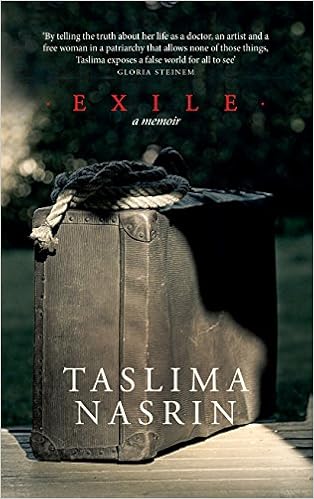
The Bengal in the title refers to both West and erstwhile East.
Both which banished writer Naslima Nasrin. Even if the accusations against Ms
Nasrin, dominantly being her fanning religious extremism and of her being a
mediocre writer are to be believed, the life of exile she was relegated to (and
written about in her book ‘Exile – a memoir’, translation by Maharghya
Chakraborty and published by Penguin) speaks loudly of the failure of a State
(two States in fact) to protect an individual and its machinations to stifle
freedom. The book also brings to the fore a strange love that Taslima Nasrin
has for India where she continues to live, largely due to her courage and
conviction, at the face of massive resistance and near lack of substantial
support.
The book is a powerful account of an individual, a writer, a
female, who has been let down by the powers that be. The book is a commentary
on how vote bank politics trumps basic human rights. The book is a testimony to
the humongous and nearly unlimited State power. The book is a note of how
personal relations, friendships, acquaintances fail to stand up in times of
adversity. Taslima Nasrin’s Exile is a book that through its diary entries,
poems, newspaper testimonials makes all the above points and makes it strongly.
In the first chapter titled ‘Forbidden’ Ms Nasrin writes how
the words, which she calls epithets, of ‘whore’ and ‘prostitute’ have become
cherished for it reminds her of the stand against patriarchy that she has taken
and the reader, provided one is unaware of her work in general, is given a
glimpse of what a woman has stood up to.
22nd November 2007 was the fateful day, and a
chapter “Farewell, 22 November 2007” has been devoted to it, when after applying
immense pressure on Ms Nasrin to leave Kolkata, where Muslim religious
fundamentalists were protesting against her, she made an exit to Jaipur, from where
she was to eventually live in ‘exile’ in various safe houses of New Delhi.
Taslima Nasrin has given the reader an image of her happy
self in Kolkata, prior to her becoming a captive at the hands of Indian State. How
she set up her house, was happily writing, was socially active and how all of
it was snatched away from her just because a state government (then a CPM
government) could not rein in fundamentalists and rather sought recourse in
sending the author away.
Ms Nasrin asks the right questions about Muslims, which a
vast majority of people wonder about. At one point (pg 153) she writes “I feel
that the ‘moderates’ do not even exist.” She invokes Gandhi, Mandela, a host of
editors, poets throughout the book who have given her strength to fight the
mighty State and who have praised her valour. The book ‘Exile’ is also about how
friendships (be it the Mr B, a minister in UPA government or any other) have
ditched her in time of need and through that becomes relatable to the average
human.
The powerful sections of the book are where Taslima Nasrin
writes about her love for India and her dislike for the comforts of Western
world where she spent 11 long years before coming to Kolkata. This narrative
comes along at various points in the book. A Bengali first and then a
Bangladeshi perhaps is how she has chosen to put it.
The outright disgusting part of the book is where she
describes her exile of nearly 8 months in various safe houses of Delhi.
Stripping a human being of basic freedom of meeting people, availing medical
facilities, going about a normal life is a gross violation of human rights and Ms
Nasrin was subject to that. She has provided a disturbing account of how due to
lack of medical help her blood pressure situation got worse and which
eventually led her to bite the bitter pill and leave India.
Maharghya Chakraborty, a PhD scholar at CSSC Kolkata needs
to be commended for a wonderful translation. The literary prowess of Taslima
Nasrin has been done justice to in English it can be safely said. The narration
is gripping, fast moving and accommodates literary flourish along with some
lovely poetry in vast sections. There could have been more clarity on the
timeline of events in general. The book is a highly recommended one for those
who would like to learn more about Taslima Nasrin, her love for India, her
fight against religious fundamentalism, the coercion of the State, machinations
of governments, and much more.